Tag: Tyre Selection

  • R24 – Tyre Selection

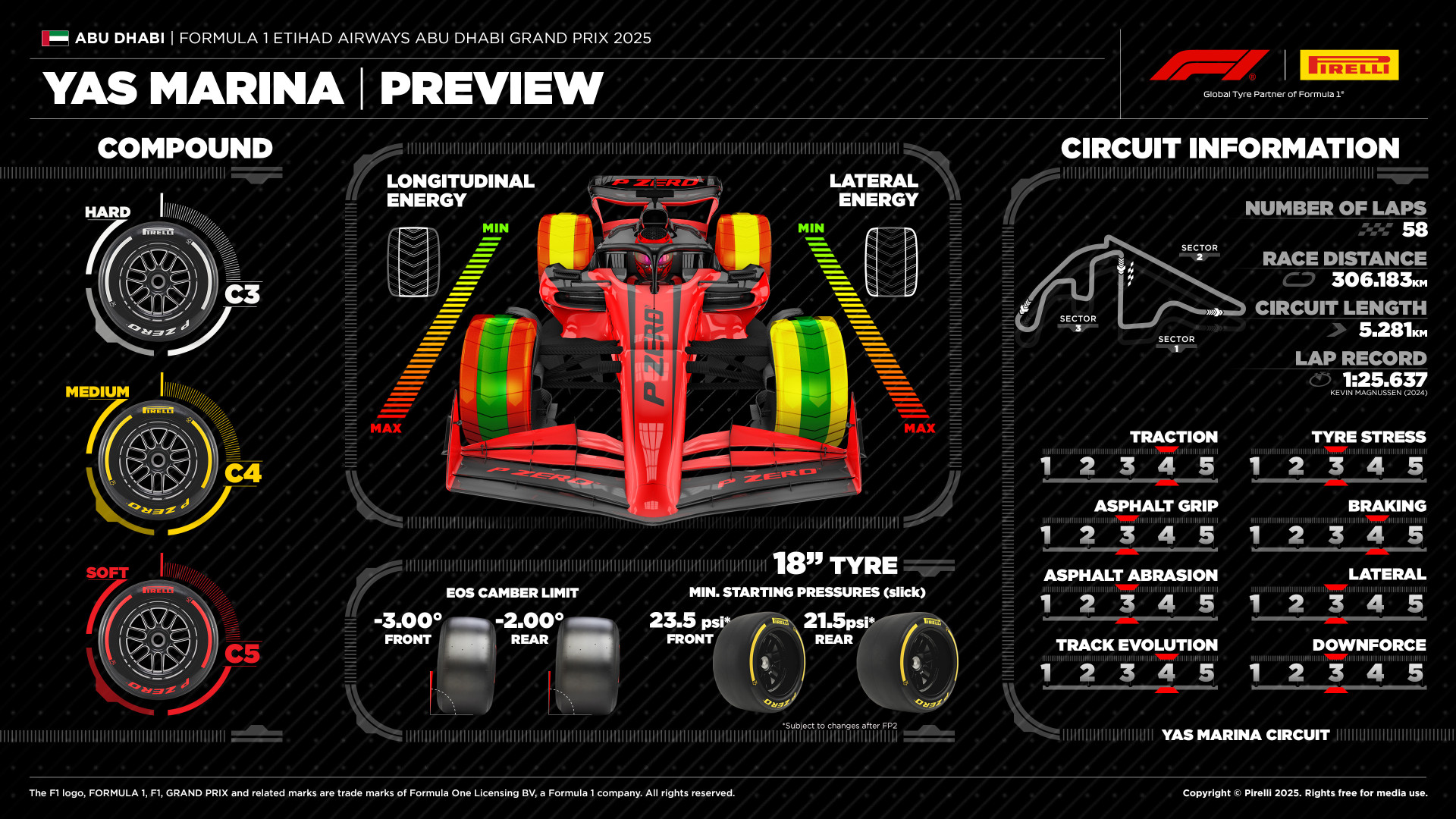
    Abu Dhabi hosts the last Grand Prix of the season and it will also be the final appearance at a race weekend for the size of tyre Formula 1 has used since 2022.

    Yas Marina has hosted the final race of the Formula 1 season, 13 times. It is a modern, cutting-edge facility, the track is 5.281 kilometres long and features 16 corners.

    The drivers know it well as it has long been the venue for the post-season test session. Designed by Hermann Tilke, the track underwent an overhaul four years ago, which slightly reduced its length, while making it faster and more flowing, producing more overtaking opportunities, especially on the 1.2 kilometre long straight between the slow turns 5 and 6.

    Another interesting section is to be found through turns 10, 11 and 12, where drivers have to brake hard, thus generating heavy lateral loads on the car.
    The track surface is made with aggregate imported from England and provides medium levels of abrasiveness and grip.

    To iron out some bumpy sections, the surface was redone this year from Turn 1 to Turn 4. As at all night races, there will be a significant drop in temperature between the first and last sessions. Track conditions can change according to when the cars are on track and they will also be affected by how much it rubbers in thanks to the support races, including Formula 2.

    Pirelli is sticking with the usual selection of compounds for the last race of the season, namely the C3 (Hard), C4 (Medium) and C5 (Soft).
    Historically, the Yas Marina track sees graining on the tyres, but as from last year this phenomenon seems to be relatively limited and the greater resistance of the current tyres could reduce it to such an extent that even the Soft, usually only used in qualifying, could be a tyre around which to put together a race strategy.

    In Yas Marina last year, 19 drivers fitted the Medium for the start, the sole exception being Hamilton who went with the Hard. The one-stop was the quickest strategy, using the hard for the second stint.
    24-AE25-Preview-EN
  • R23 – Tyre Selection

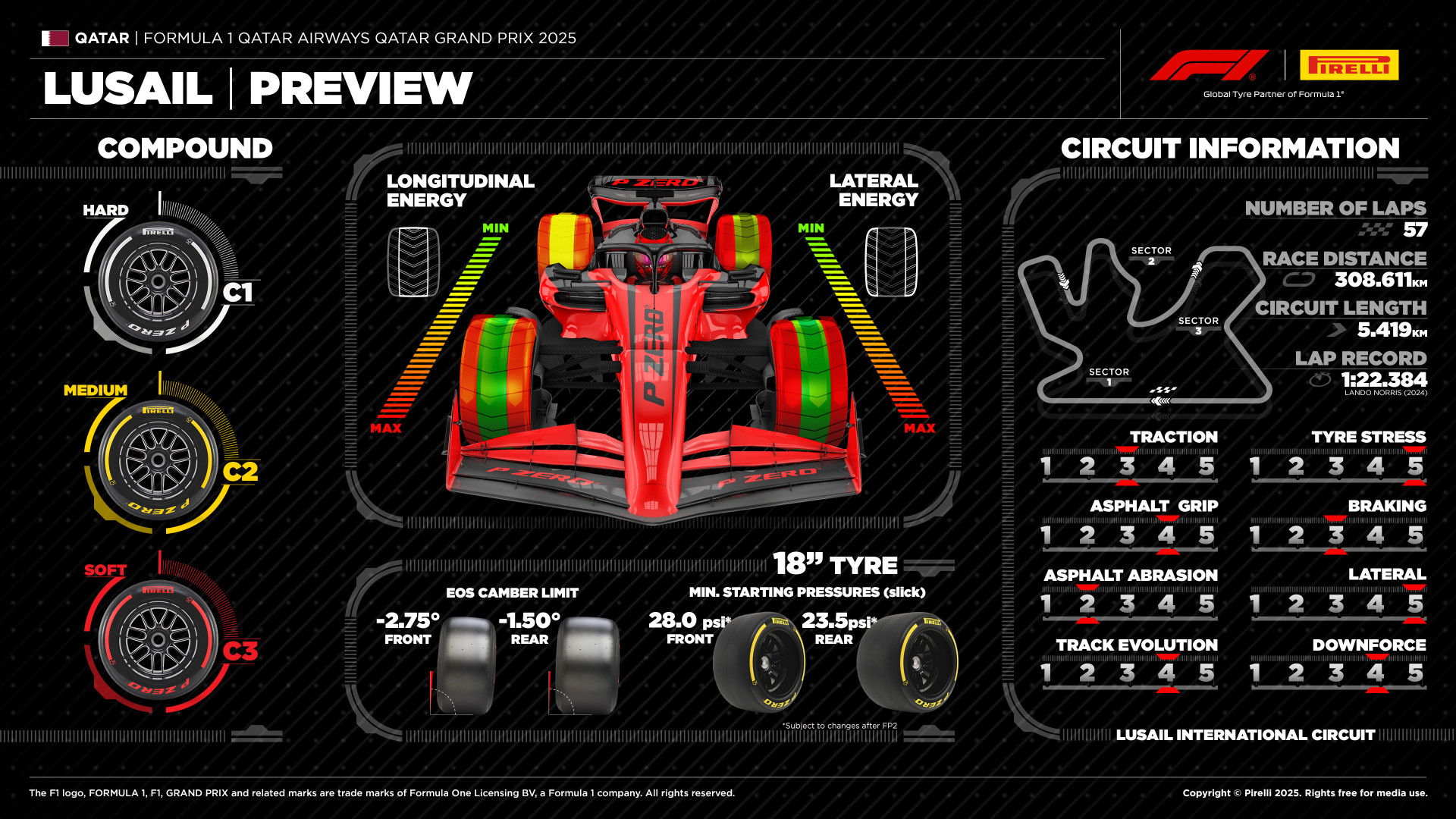
    The Qatar Grand Prix is the penultimate race of the season and the last to be run to the Sprint format. It comes just one week on from Las Vegas, 13,000 kilometres as the crow flies from this week’s venue in Lusail.
    Both races and indeed the final one in Abu Dhabi, take place at night, but the weather could not be more different.

    Conditions were cold on track in the Nevadan desert, but in Qatar drivers will have to deal with heat and humidity similar to that experienced in Singapore.
    The Middle Eastern track is particularly demanding for the tyres and that has led to the introduction of an exceptional measure.

    The three hardest compounds in the Pirelli range have been selected for Doha. The C1 (Hard), C2 (Medium) and C3 (Soft) are the obvious choice at a track where tyres are subjected to energy levels similar to those experienced in Suzuka and indeed, these are the only compounds that have ever been run at the this Grand Prix.

    The majority of the corners at the Lusail track are high speed, which means the tyres have little time to recover and the section which works them the hardest is from turns 12 and 14. The track surface which is quite smooth has usually led to graining which contributes to producing a high wear rate on the tyres.

    The Lusail circuit was originally conceived as a motorcycle racing track, which is clear from its rather unique layout; fast and twisty with a straight that is over a kilometre in length.
    The circuit on the outskirts of Doha, presents the drivers, cars and tyres with some unusual challenges. It boasts 16 corners, ten of them right handers while its desert location means that sand often gets blown onto the track, inevitably influencing track evolution. In an effort to prevent this, there are several areas of artificial grass around the circuit.

    All drivers started the Qatar Grand Prix on the Medium tyre with the exception of Nico Hulkenberg who opted for Hards. The one-stop strategy proved the most popular, with drivers looking to extend the first stint on the yellow-banded tyre, managing to make it last well past the half race distance.

    23-QT25-Preview-EN
  • R22 – Tyre Selection

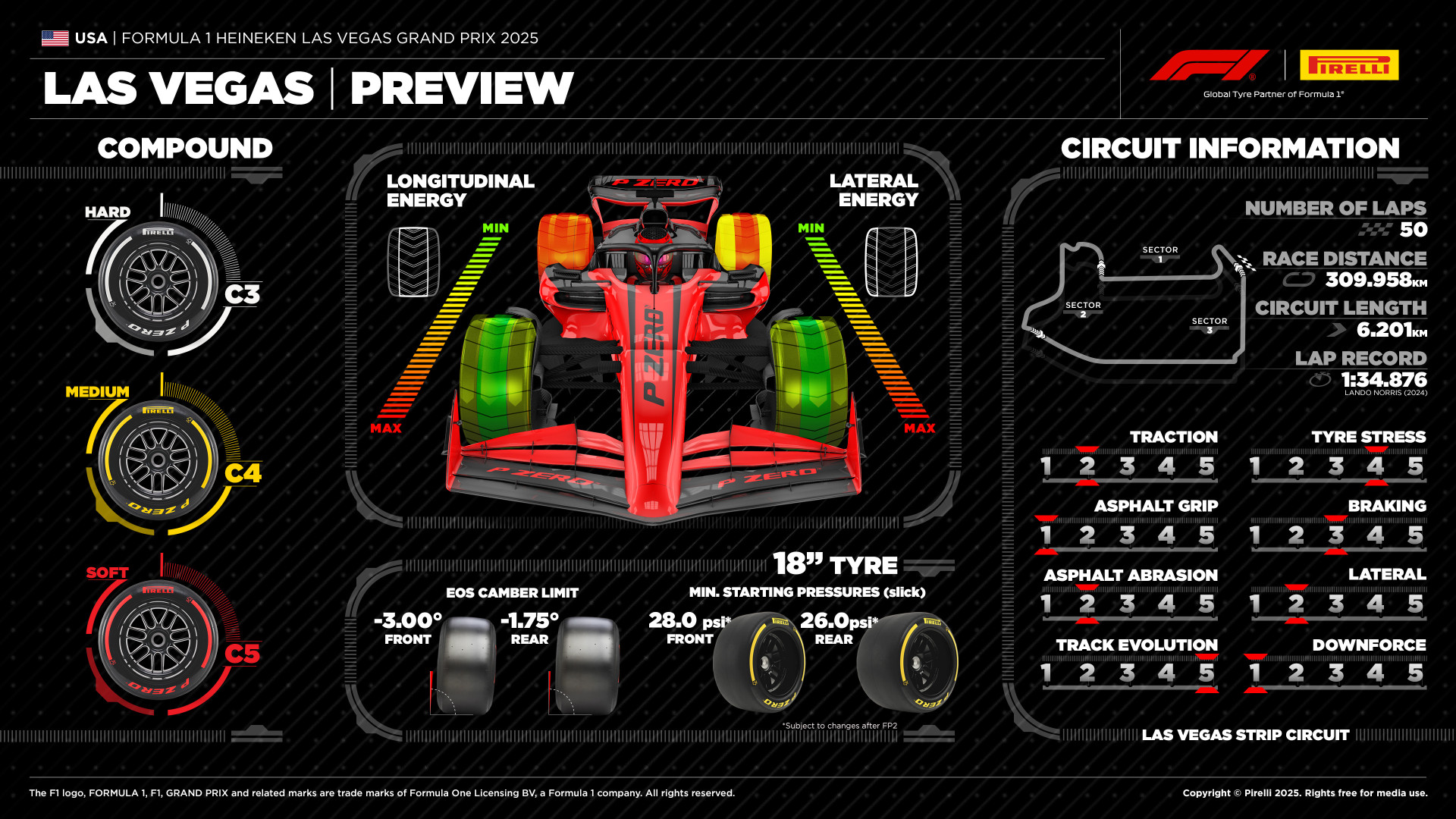
    The Las Vegas Grand Prix is the last of three rounds of this year’s world championship to be held in the United States, before the season comes to a close with the final two races in the Middle East.

    The race is run over 50 laps of the Las Vegas circuit, which has 17 corners and is unique because of the speeds attained and its technical layout.
    At 6.201 kilometres, it is the second longest on the calendar after Spa and one of the fastest in terms of average lap speed.

    In 2024, Alex Albon in his Williams hit the highest top speed of the season (368 km/h) on the straight between turns 12 and 14. At the latter corner, drivers experience very strong deceleration when braking and it is one of the best overtaking opportunities.

    Almost 80% of the lap is spent at full throttle, the cars passing famous landmarks such as the Venetian and Casears Palace, which hosted the first two Las Vegas GPs.

    For the third consecutive year, the compounds chosen for the Las Vegas street circuit are the C3 (Hard), C4 (Medium), C5 (Soft). One of the main challenges will be tyre temperature management especially during qualifying.

    The fact the sessions are running earlier this year will help the drivers, as conditions won’t be quite as cold, thus helping tyre warm-up.
    However, the preparation lap prior to the flying lap will still be crucial to get the tyres up into the right temperature window. Furthermore, this year’s tyres have improved mechanical properties, which should see a reduction in degradation, which was particularly noticeable on the medium compound last year.

    All but four drivers chose to start on the medium, Fernando Alonso went for the soft, while Sergio Perez, Valtteri Bottas and starting from pitlane Franco Colapinto, preferred the hard.
    The two-stop was the preferred strategy, drivers pushing tyres to the limit rather than having to manage them carefully.

    22-LV25-Preview-EN
  • R21 – Tyre Selection

    A fortnight on from the previous round, Formula 1 returns to the American continent for the Sao Paulo Grand Prix. The Brazilian weekend features the penultimate Sprint, prior to the final one of the season in Qatar.

    The circuit named in honour of Brazilian racer Jose Carlos Pace is 4.309 kilometres long.
    The layout at Interlagos is interesting, with hints of an anti-clockwise oval circuit, which the drivers deal with 71 times in the race.

    It boasts 15 corners with relatively balanced lateral and longitudinal forces that do not put any undue strain on the tyres, as they are subjected to loads distributed equally between the front and rear axles.

    The combination of several straights and much twistier sections offers plenty of overtaking opportunities, although it also means there’s a higher risk of Safety Cars and incidents.

    At this time of the year, the weather and temperature can be very variable, with a risk of frequent rain and the inevitable use of wet weather tyres.

    This year’s compound selection for the Sao Paulo Grand Prix harks back to 2023, with the C2 (Hard), C3 (Medium), C4 (Soft), therefore one step harder than the trio used last year.

    Last year, the dry weather tyres were not required for the race, but when used on Friday and Saturday, they showed high levels of wear, as well as graining, especially on the rear axle.

    The circuit had been completely resurfaced, thus leaving a very smooth surface, less abrasive than in previous years, although still with plenty of bumps around the track.

    Last year, qualifying and the race both took place on Sunday, with bad weather forecast, the race director decided to run qualifying at 07.30 as well as bringing the Grand Prix start time forward to 12.30.
    Dry weather tyres were never used at any time during the day.

  • R20 – Tyre Selection

    Formula 1’s America journey continues with a trip south for the Mexico City Grand Prix, one week on from the round in Austin.
    As usual, the atmosphere inside the Autodromo Hermanos Rodriguez will be electrifying because of the exuberance of the fans who pack the grandstands in the spectacular Foro Solo stadium section.

    The race is run over 71 laps of the 4.304 kilometres of Mexico City’s Autodromo Hermanos Rodriguez which boasts 17 corners.
    Its main peculiarity is its altitude, which at over 2,200 metres above sea level means the air is very rarefield. Therefore the cars generate less downforce making car set-up and technical management particularly demanding for the teams.

    The main straight is over 1.2 kilometres long, on which the cars reach very high top speeds, partly down to the minimal downforce. The track surface is very smooth and at the start of the weekend does not provide much grip, as it does not get used much.

    As was the case in Austin last weekend, for the Mexican round there is again a jump in the compound selection between the hardest of the three and the medium.

    While the Medium and Soft are the C4 and C5 respectively, as in 2024, the Hard will now the C2. For the Mexico City track, this compound is an extremely conservative choice, with a considerable delta in terms of lap time compared to the other two, while also offering less grip.

    Last year, the soft only came into play in qualifying and then in the race, only in an attempt to secure the extra point for setting the fastest lap, but now the scenario could change considerably.

    In 2024, all drivers, except Sergio Perez, adopted a one-stop strategy last year. Most started on the medium compound, while six driver, all of whom went on to finish outside the top eleven, preferred the hard for the first stint.

  • R16 – Tyre Selection

    The Monza event is always special but this year, it is even more so. It will be the 75th time that the Autodromo has hosted a Formula 1 World Championship race, more than any other circuit in the history of motor racing’s blue riband category.

    The Monza track holds the record for the highest average race speed, courtesy of Michael Schumacher in a Ferrari with a figure of 247.586 km/h in 2003, as well as the fastest average speed of 264.362 km/h for a qualifying lap, set by Lewis Hamilton at the wheel of a Mercedes in 2020.

    Last year pole went to Lando Norris with an average speed of 263 km/h. Easy to understand therefore why the venue is universally known as the Temple of Speed.

    The 5.793 kilometre track has 11 corners and drivers spend 80% of the lap at full throttle, the cars running the lowest aero downforce level of the season with the aim of reducing drag to a minimum.
    In this context, stability under braking and traction out of the corners is key, especially at the chicanes such as the Prima Variante and the Variante Ascari, where the drivers need to scrub off speed very rapidly.
    Lateral forces come into play at the fastest corners, such as Biassono and the legendary Parabolica, now renamed in honour of Michele Alboreto.

    After the track was completely resurfaced in 2024, this year Monza has concentrated on improvements to the public areas.

    There is no change in compounds compared to last year, when the track had just been resurfaced for the Italian Grand Pri at the Autodromo Nazionale di Monza.
    The C3 (Hard), C4 (Medium) and C5 (Soft).

    Twelve months on, inevitably the surface will have aged, but it is unlikely to have any significant effect on the range of possible strategies at this circuit, where cars run in the lowest aerodynamic downforce configuration of the season.

    It is likely that the most popular choices for the race itself will be the Hard and Medium. One can assume that the level of graining will be lower than last year as the track will now be bedded in.

    It is difficult to overtake at Monza, primarily because of the reduced effectiveness of the DRS, with the cars running minimum aero downforce levels. This too tends to swing the balance in favour of a one-stop strategy.

  • R15 – Tyre Selection

    This weekend’s Dutch Grand Prix marks a milestone in Pirelli’s time in Formula 1, as this race will be the five hundredth world championship round of motorsport’s blue riband category in which the Italian marque has had an official presence.

    A lap of Zandvoort track is 4.259 kilometres in length, running through the dunes on the North Sea coast, just under 40 kilometres from the capital of the Netherlands.

    It boasts 14 low to medium speed corners – four to the left and ten to the right – of which the third and last are banked at angles of 19 and 18 degrees respectively, must steeper than the turns at Indianapolis.
    These corners generate very high vertical and lateral loads on the tyres, which requires the teams to pay close attention to set-up and management of the car-tyre package.

    The aerodynamic downforce level required is very high, similar to that seen in Budapest. The track usually offers low levels of grip and this can be greatly exacerbated by sand blown onto the surface by the coastal winds.

    For the race in the Netherlands, Pirelli has gone a step softer in terms of compounds than last year. The teams will have a choice of the C2 (Hard), C3 (Medium), C4 (Soft).

    The decision, taken in conjunction with the FIA, has the aim of increasing the likelihood of a strategy based on two stops, rather than just the one-stop, which has been the predominant choice since this race returned to the calendar in 2022.

    In 2024, 16 drivers lined up on the gird on the Medium tyre, while three drivers went for the Soft tyre, with one driver starting from the pit lane on the Hard tyre.
    Three quarter of the field made just one stop during the race, taking on the Hard tyre as the second set.

  • R14 – Tyre Selection

    The Hugaroring provides the backdrop to the last few days of Formula 1 track action prior to the summer break.

    This weekend’s race will be the fortieth anniversary of the Hungarian Grand Prix and the Hungaroring track will also be in use on the Tuesday and Wednesday 5th and 6th of August, when Pirelli is running a 2026 tyre development test.

    The Hungaroring facility is currently undergoing a major transformation. Firstly, the paddock area was refurbished and this year, the main changes relate to the pit lane and the main straight, as well the pit complex and the main grandstand.

    Usually, track evolution over the weekend is very high here, especially during the first two days. Graining could put in an appearance during Friday free practice, before gradually decreasing the more the track gets rubbered-in.

    The trio of slick tyre compounds is the same as last year: C3 (Hard), C4 (Medium) and C5 (Soft).

    Up until last year, these would have been the softest tyres of all, but this year, the C6 was introduced.
    However, the new compound would be too extreme a choice for a track that exerts this level of energy density on the tyres for every lap.

    The most popular strategy was the two-stop last year, running various combinations of the C3 and C4. The Medium performed best and 13 drivers chose it for the start.
    Of the remaining seven, four went with the Soft and three with the Hard.

  • R12 – Tyre Selection

    The midpoint of the 2025 season sees Formula 1 return to where it all began 75 years ago. The first Grand Prix to count towards the Drivers’ World Championship was held on 13th May 1950 at Silverstone.

    Silverstone has hosted 59 Grands Prix, more world Championship events than any other circuit with the except of Monza (74).
    It’s layout has remained more or less unchanged throughout the years.

    At 5.861 kilometres, it is one of the longest tracks on the calendar, with 18 corners, 10 to the right and 8 to the left.
    The circuit is in almost year round use with four and two-wheeled racing categories and so it provides good grip right from Friday’s first free practice session.

    Despite taking place at the height of summer, the English weather can often be unpredictable with very changeable temperatures and wind and rain suddenly putting in an appearance.

    The compounds for this year are- C2 (Hard), C3 (Medium), C4 (Soft), which is a step softer than last year.
    The aim is to create a wider range of strategy options for the race. In 2024, when the C3 was the Soft, it was used by just a few drivers in the closing stages of the race following the rain.

    All dry compounds and the intermediates were used during the 2024 British Grand Prix. 17 drivers opted to line up on the starting grid on the medium, the only exceptions being Ocon and Zhou on the Soft and Perez on the Hard tyres.

  • R10 – Tyre Selection

    The Canadian Grand Prix is the tenth round of the season, the second in North America after Miami. Montreal is one of the staples on the calendar, for many years the only round in this part of the world.

    The Gilles Vileneuve Circuit is a semi-permanent facility built on the manmade island of Notre Dame, on the saint Lawrence river, which was home to the Expo ’67 World’s Fair and some events in the 1976 Olympic games.

    The track was completely resurfaced last year, but it has retained its low abrasiveness and reduced grip that has always been one of its characteristic features.

    4.361 kilometres long, it features a sequence of straights and tight chicanes, with 14 corners (six to the left and eight to the right). It’s a real stop n go track where stability under braking and efficient traction are vital.

    Overtaking is possible, partly down to the three DRS zones. The best bet has always been the braking point at the end of the straight that takes the drivers back to the start.
    The following chicane, where drivers cant still use DRS from the previous activation zone, has often seen some spectacular accidents, which has led to it being known as the “wall of champions” after no fewer than three world champions, Damon Hill, Michael Schumacher and Jacques Villeneuve all crashed into it during the 1999 race.

    For the third time this season, the softest trio of compounds will feature on the track. It’s the first time after appearing in Imola and again in Monaco the C6 (Soft), C5 (Medium) and C4 (Hard).

    This weekend, when using the new C6, teams and drivers will be able to make the most of the information and data gathered at its two previous appearances.

    The Gilles Villeneuve Circuit is a track where the lateral forces exerted on the tyres are medium to low, while the longitudinal ones are a bit more severe, although not particularly high, because of the cars being subjected to strong deceleration followed by sharp acceleration.

  • R9 – Tyre Selection

    The second triple-header of the season concludes at another classic Formula 1 track, the Barcelona-Catalunya circuit that has hosted the Spanish Grand Prix every year since 1991.

    It’s an eagerly awaited event as the track is one of the most complete in offering a full range of technical challenges. That’s why it was one of the most popular tracks for testing, on the basis if a car works well here it does everywhere else.

    Since the inaugural race in 1991, the track has undergone several modifications, especially in the final part, with various attempts made to create overtaking opportunities.

    In 2023, the original configuration was restored, with the final two corners linked so as to make for a much faster entry onto the pit straight, one of the longest on the calendar.

    In the race, drivers tackle 66 laps of the 4.657 kilometre track with its 14 corners. The highest downforce corners are turns 3 and 9, both right handers.

    Not only is the track challenging for the cars, it also places high demands on the tyres.
    After two consecutive rounds featuring the softest trio in the 2025 range, as usual Pirelli has chosen the hardest, namely the C1 (Hard), C2 (Medium) and C3 (Soft).

    The forces exerted on the tyres are medium to high, because of the many fast corners, such as turn 3 and the final two, both of them righthanders. The corner of the car subjected to the greatest stress is the front left, as right hand turns are in the majority.

    Even if the Barcelona-Catalunya circuit is no longer used for testing by the teams, because of the virtual elimination of in-season testing a reduction in pre-season work, it is still a very important test bench.

  • R8 – Tyre Selection

    The Monaco Grand Prix is one of the most iconic and prestigious events on the Formula 1 calendar, not just because of its long history but also because of the mystique that surrounds it.

    Narrow streets, tight turns, steep climbs and descents and the famous tunnel that leads onto the harbour are some of the defining characteristics that make Monaco a track like no other. It’s a place where precision is more important than power, with virtually no room for mistakes.

    Winding its way through the streets of the Principality usually open to normal traffic, the track is 3.337 kilometres long and tackled 78 times in the race.
    Very narrow with 19 corners, some of them very tight, there are virtually no run-off areas and the barriers are so close that the drivers often brush up against them.

    Around half the track has been resurfaced, specifically from Turn 12 to Turn 3, so that this section should now be as smooth as the rest of the circuit.
    This type of surface does not promote tyre grip and could lead to graining, especially in the first couple of practice sessions.

    For a second consecutive race, Pirelli has selected the three softest compounds from the 2025 range.
    As in Imola last week, the C4 (Hard), C5 (Medium) and C6 (Soft), with the first two being the mandatory compounds for the race.

    This weekend will see an important change to the regulations, specifically for this event only.
    During the race, two pit stops will be mandatory, the aim for this is to inject more excitement into a race that has often been very linear and predictable.

    In the Monaco Grand Prix drivers usually pit just once to change tyres, but last year out of theoretical field of 20, only six drivers made an actual in-race pit stop.

    That was because the race was red flagged on the opening lap so that all the drivers still in the race were able to immediately adhere to the rule that two different compounds must be used, with the nine who started on the medium switching to the hard and the remaining 11 doing the opposite.

  • RND 7 – Tyre Selection

    The first quarter of the season is now done and dusted, apart from a brief interlude in Canada in mid-June, the European season starts now, and goes on until the Italian Grand Prix on 7th September.

    The Emlia-Romagna e del made in Italy Grand Prix takes place at the Imola Circuit, named in memory of Enzo Ferrari and his son Dino.

    Imola’s Autodromo Enzo e Dino Ferrari is one of the most iconic and technical tracks on the Formula 1 calendar.
    Situated in the heart of Italy’s Motor Valley, it is 4.909 kilometres long, with 19 corners – ten to the left and nine to the right – and runs anti-clockwise, which puts it in the minority of race tracks worldwide.

    It’s old school, rather narrow with high and aggressive kerbs, as well as several natural changes of elevation and corner sequences that alternate between requiring heavy braking and some flowing sections.

    Tyre management is affected by the many acceleration and braking points, with tyres subjected to a low average load and limited degradation.
    However, the high kerbs can increase mechanical stress, especially on the suspension and tyres.

    The new C6 compound is making its race debut in Imola, as Pirelli has chosen the softest trio of compounds in its 2025 range for this weekend, with the C4 (Hard), C5 (Medium) and C6 (Soft).

    Last year, the one-stop strategy proved the most competitive. 15 drivers started the race on the Medium (C4), three on the Hard (C3) and two on the Soft (C5).

    The harder compounds worked best, offering very consistent performance, with limited degradation. Those who started on the soft tyre had to make two stops.

  • R6 – Tyre Selection

    Formula 1 moves from shore to shore, from the Red Seas to the Atlantic Ocean, from the Asian continent to North America and from Saudi Arabia to the United States.

    The Miami Grand Prix is the first of three to be held in the United States this year, as has been the case since 2023, with the Floridian round joining the calendar in 2022.
    The race is held on a track around the Hard Rock Stadium, home to Miami Dolphins NFL team and one of nine ATP Masters venues.

    The compounds chosen by Pirelli is the same as that used a fortnight ago in Saudi Arabia. C3 (Hard), C4 (Medium), C5 (Soft), just as in Jeddah, this is a step softer than last season.

    The surface of the track that runs around the stadium is very smooth, exposing the tyres to moderate longitudinal and lateral forces.
    Thermal degradation will be a major factor, as temperatures are expected to be very high, given that last year’s track temperature exceeded 55Β°C.

    The surface was relaid in 2023, as with the other temporary Grand Prix circuits, grip levels will increase significantly the more the track rubbers-in across the weekend.

    The Miami International Autodrome is 5.412 kilometres long, the race being run over 57 laps.
    The layout incorporates parking lots, service roads and some public roads with a total of 19 corners, seven to the right and 12 to the left.

    So far, the Miami Grand Prix has been a one-stop race, including last year’s.
    The medium tyre was the tyre of choice for the opening stint for 15 of the 20 drivers, before a switch mainly to the hard, with just a couple of drivers opting for the soft tyre, which actually displayed relatively low degradation.

  • R5 – Tyre Selection

    The first triple-header of the 2025 season is coming to an end on the shores of the Red Sea.

    The Saudi Arabian Grand Prix first appeared on the calendar in December 2021, with the next three events taking place in March and this year will be the first time it will run in April.

    The track is 6.174 kilometres long and one of the fastest of the season with drivers spending around 80% of the lap with the accelerator buried to the floor, even though it is fair twisty and boasts a record number of corners, 27 in fact.

    The track surface is not very abrasive, with an average level of roughness, but the lateral forces exerted on the tyres are considerable, although not at the level to be found at Suzuka or Barcelona for example.

    Graining can put in an appearance, especially in the first free practice sessions as the track is very dirty to start with, because it is rarely used for motor racing.
    However, with several support categories also racing, track condition improves over the course of the weekend, so that this phenomenon diminishes.

    The choice of compounds for the first four races of this season were the same as last year’s but for round five, Pirelli has taken a softer step.
    C3 (Hard), C4 (Medium) and the C5 (Soft) are the trio selected Jeddah.

    In 2024, Bottas was the only driver to pit twice, with all the others going for the one-stop, with the vast majority starting on the Medium and then switching to the Hard tyre for the second stint.

  • R4 – Tyre Selection

    The Sakhir circuit boasts several layouts, with two different ones used for the races in 2010 and 2020, but the current one is 5.412 kilometres in length and features 15 corners, 9 to the right and 6 to the left.

    The track is one of the toughest on the calendar when it comes to tyres, especially in the braking areas and when traction is required.
    The aggregate used for the asphalt at the Bahrain International Circuit is still very abrasive despite it being quite old now.

    Temperature will be a very important variable when it comes to tyre management at the fourth race of the year.
    As was the case in Suzuka, the teams will have a choice of the three hardest compounds in Pirelli’s range.

    The C1 (Hard), C2 (Medium) and the C3 (Soft), however, the Sakhir track characteristics and indeed the temperatures, will require a different approach to that adopted last week in Japan.

    All the teams, will have a good baseline from which to start work, given that in the last week the circuit hosted the only pre-season test. Which means everyone will have plenty of data to work with when it comes to setting up the cars and choosing the best strategies for qualifying and the race.

    Bahrain is the one Grand Prix where a two stop strategy would seem to be a given, and that was the case last year.
    All drivers made at least two stops, whilst some even stopped three times.
    The Soft and Hard tyres are the preferred compounds, with the vast majority opting to start on the C3.

  • R3 – Tyre Selection

    The Suzuka track is one of the most spectacular and demanding on the calendar, as well as being the only circuit of the season with a figure of eight layout.
    Located in the Mie Prefecture, the venue is owned by Honda whose Suzuka factory, built in 1960 is one of its main sites in Japan.

    The track is regarded as being demanding for both car and driver, 5.807 kilometres in length, it is made up of 18 corners, some of which are part of motor racing history, such as the Esses in the first sector.

    The C1, the hard compound of the 2025 range, makes its season debut at this the third round, joined as usual by the C2 (Medium) and C3 (Soft).
    That’s because Suzuka is one of the toughest tracks on the calendar when it comes to tyres and Pirelli has therefore always selected the hardest trio of compounds.

    Something new for this year is the fact that a large part of the track has been resurfaced, from the exit of the last chicane to the end of the first sector.
    This is an important section, as it features medium and high speed corners, some of them long ones, such as the first two after the start-finish straight, where tyres come under a lot of stress.

    As already mentioned, the three hardest compounds in the range will be available. It is worth noting that, of the three, the C1 is the one that most closely resembles its 2024 iteration, while the C2 especially and the C3, have undergone the most changes in terms of performance, being softer than last year.

    In 2024, the race was won by Max Verstappen, followed home by Red Bull team-mate Sergio Perez and the then Ferrari driver Carlos Sainz.
    The field was split pretty fairly evenly between the Medium and Soft for the first stint, with 12 choosing the C2 and eight the C3.

    But the race strategy was then influenced by the race being red flagged following a collision between Albon and Ricciardo, with seven drivers changing compounds for the restart off the grid.

  • R2 – Tyre Selection

    We are back once again as we return to China, which is the first Sprint race weekend of the season.

    The Shanghai track is 5.451 kilometres long and its layout is based on the Chinese character “shang” meaning “upwards” or “above”.
    The circuit features several slow corners, such as the first three, turn 6 and 14 and high speed corners like the combination from 7 to 8.

    There are two long straights, the one that crosses the start-finish line and another between turns 13 and 14, which is over a kilometre in length.

    Last summer, a new surface was laid down on the track and the pit lane at the Shanghai International Circuit. It has only been used a few times towards the end of 2024 and should be smoother than before, but it’s logical to expect the track to evolve very quickly.

    The trio of compounds chosen are the same as last year, C2 (Hard), C3 (Medium) and C4 (Soft). The last two were in use in Melbourne last weekend, while the first as run extensively during the three day test in Bahrain.

    Another important factor to consider this weekend will be the temperatures.
    It’s the first time that Shanghai hosts the Grand Prix in March when average temperatures rarely exceed 18Β°C.

    There were three interruptions last year – one VSC and two Safety Cars – which significantly influenced the outcome of the race, both in terms of the number of stops and the sequence in which the compounds were used.

    Three of the drivers who finished in the top ten made just one stop, six pitted twice and one even three times.
    The majority of the drivers opted to line up on the grid on the medium tyre, which also completed the most stints.

  • R1 – Tyre Selection

    It’s officially race weekend (finally) and the 2025 season is here, we are back in Australia for Round 1.

    The track surface has not changed since it was renewed in 2022 and is not too harsh on the tyres.
    The only modification to the track layout, which features some sections made up of roads usually open to normal traffic, comes at Turn 6 and 7 where the barriers and kerbs have been modified.

    5.278 kilometres long, the circuit combines both fast straights with low to medium speed technical corners and some heavy braking points.

    Summer is sliding into autumn at this time of year in Australia and the weather can be very changeable, with big swings in temperature from one day to the next and rain has been known to put in an appearance.

    Having softened up its compound choices last year, Pirelli has confirmed the same compounds for the opening round, with the trio of C3 (Hard), C4 (Medium), C5 (Soft).
    However, compared to a year ago the tyres have evolved in terms of the characteristics of both construction and compound.

    Last year, the most popular strategy was a two-step, with the Hard tyre doing most of the work, completing 80% of all the laps, with an average stint length of 22 laps.
    Only three drivers opted to start on the Soft, while two drivers lined up on Hard tyres, making Medium the most popular compound on the grid.

  • RW 24 – Tyre Selection

    The Abu Dhabi Grand Prix weekend brings the curtain down on the longest ever Formula 1 season!

    As has been the case at this track, Pirelli have chosen its three softest compounds for the event, which are C3 (Hard), C4 (Medium) and C5 (Soft).

    Thanks to significant changes to the track layout introduced in 2021, its a much faster and flowing track, with several overtaking opportunities.
    In general the forces exerted on the tyres are in medium to low range, because of the high speed corners.

    The surface offers little grip and its level of abrasiveness is average for the season. However temperatures will play an important role, with two of three practice session taking place in daylight, FP2 and the race gets underway at sunset and then qualifying at night.
    Therefore track conditions can change quickly as the temperatures drop and they will evolve rapidly as the track rubbers in.

    On a track where graining could have a significant impact and where overtaking is possible, a two stop strategy seems like the most preferable, as was the case last year.
    As well as the undercut is very effective, and in order for a one-stop to work it requires a great deal of tyre management.

  • RW 23 – Tyre Selection

    Formula 1 now heads to Qatar after Max Verstappen won the Drivers’ title in Las Vegas for a fourth consecutive year, however three teams are still in with a chance to claim the Constructors’ title as there is still 103 points on the table.

    The last back-to-back of the longest ever Formula 1 season gets underway in Qatar, the sixth Grand Prix weekend to run the Sprint format this season.

    An eleven hour time difference separate Doha from Las Vegas. They are both night races, held on the edge of large deserts, but that’s where the similarities end.

    When it comes to the tyres to be used Pirelli have picked C3 (Soft), C2 (Medium), C1 (Hard). With the Lusail track, the tyres are subjected to energy levels comparable to those at Suzuka and Silverstone so the hardest of compounds will be used.

    This is the third edition of the Qatar Grand Prix, the two previous events having been held in 2021 and 2023.
    Last year the weekend was affected by a decision taken by the FIA, imposing a maximum of 18 on the number of laps that one set of tyres could complete in the race, which led to all the driver making three pit stops.

    Over the past few months, the FIA and Pirelli have worked together to prepare for this Grand Prix to ensure that what happened last year will not be repeated.
    The pyramid-shaped kerbs have had their tips rounded off at seven of the track’s 16 corners.

    It’s hard to avoid the high temperature emanating from the Lusail track which was resurfaced in time for last year’s Grand Prix, to the extent that graining could be a feature.
    This could have a significant impact on race strategy with the tyres possibly suffering from significant thermal degradation.

  • RW 22 – Tyre Selection

    The Las Vegas Grand Prix is the third round this year to be held in the United States, following on from Miami and Austin.

    After the 7.004 kilometre-long Spa-Francorchamps circuit, the Nevadan track is the second longest on the calendar at 6.201 kilometres.
    It features 17 corners, tackled over 50 times in the race. It is a high speed venue, with three straights and top speeds that hit 350 km/h last year.

    Once again this year, track action begins with two free practice sessions getting underway on Thursday, leading up to the race on Saturday night, run entirely under the floodlights.

    As has become the normal for street circuits, Pirelli has selected the three softest compounds in the race – C3 (Hard), C4 (Medium) and C5 (Soft).

    The main challenge on the tyre front will be the warm up, especially during qualifying and for the front axle in particular. Drivers will have to be careful to bring the tyres up to temperature without overworking them, avoiding any lock-ups at the heaviest braking points.

    Furthermore, low temperatures lead to reduction in grips and that can cause increased graining.
    These factors could lead to a speeding up of the wear process, which suggests a two-stop strategy, which was in fact the most popular choice last year.
    However a one-stop can still be quite competitive, especially if the driver gradually brings the tyres up to temperature, prolonging its life over a long stint.

    As always on a street circuit, red flags and Safety Cars are a strong probability with all the unknowns that can bring, including a restart in terms of tyre temperature management.

  • RW 21 – Tyre Selection

    The Sao Paulo Grand Prix brings the curtain down on Formula 1’s long trip in the Americas, as we head to our final stop on the triple header.

    There is a common thread, that links all three of the tracks together, namely new asphalt. However, while in Austin and Mexico City only sections of the tracks had been resurfaced, in Sao Paulo all 4.309 kilometres has been renewed including the pit lane.

    Therefore, the track surface will be a completely unknown factor for drivers and teams this weekend. Complicating the puzzle further is the fact Pirelli have chosen to bring a softer trio of compounds than last year, they are: C3 (Hard), C4 (Medium), C5 (Soft).

    On top of that it’s a Sprint weekend, so that there is only free practice session for teams to find the best set-up.

    At Interlagos, the lateral and longitudinal forces exerted on the tyres around the 15 corners of this anticlockwise track are medium to low intensity and well distributed across both axles.

    Usually the fastest strategy is a two-stop, favouring the use of the softer compounds. Last year, all bar one of the drivers chose to start on the Softs, but a red flag after the start allowed for a switch to Mediums.

    https://twitter.com/pirellisport/status/1851256011983630551?s=46&t=aXLQ2Py0qaT52rhG6u6Lig

  • RW 20 – Tyre Selection

    The second stop of our triple header is Mexico City, where the circuit is named in honour of the brothers, Pedro and Ricardo Rodriguez.

    The tyres for this this weekend are C3 (Hard), C4 (Medium), C5 (Soft), which is a step softer than past race weekends, this decision was taken in order to open up more strategic options for the race.

    The first day of track action, Friday, will be slightly different than usual. The second free practice session will be entirely given over to validate the softer compounds in Pirelli’s 2025 race (C4, C5 and C6).
    The session is extended to 90 minutes instead of the usual 60 minutes, and all drivers and teams will have to follow a specific programme established by Pirelli.

    The Hermanos Rodriguez track is 4.304km long, with 17 corners and a surface that is low in terms of its severity on tyres. They have resurfaced the section between turns 12 and 15 in the third sector – the smooth asphalt and the fact the track is hardly used means that grip levels are rather low at the start of the weekend.

    Mexico City is located at over 2000 metres above sea level and the rarified air has an influence on car performance, reducing the aerodynamic downforce generated by the cars.
    One of the consequences of this is that top speeds reached are very high, despite a configuration that actually looks typical of tracks that require maximum downforce.

    In terms of strategy, this is a usually a one-stop race. Last year, the majority of drivers tried to manage the Medium to lengthen the first stint as much as possible.

  • RW 19 – Tyre Selection

    Formula 1 is back and this year’s United States Grand Prix is the first leg of an all-American triple-header also sees changes to the track at COTA as most of it has been resurfaced.

    The abrasiveness of the track could therefore have changed since last year, given that a new layer of bitumen is usually smoother than an old track surface.

    The compounds chosen are the same as those used for the past two editions of the Austin round which are, C2 (Hard), C3 (Medium), C4 (Soft).

    In terms of the forces exerted on the tyres, the loads at COTA are fairly evenly distributed between the front and rear axles, and are more lateral that vertical.
    Usually, degradation is thermal and is therefore linked to the ambient temperature which in Texas in October can fluctuate considerably from one day to the next.

    In terms of strategy, we will need to wait and see how the new surface may affect it. But with Saturday’s Sprint that should provide plenty of useful data.
    In last year’s short race, the Medium was chosen by the majority of drivers, although some risked the soft.

    Normally a two stop has always been the quickest here, especially as a one-stop involves a lot of careful degradation management.

  • RW 18 – Tyre Selection

    There are around seven thousand kilometres separating Baku and Singapore and the entire Formula 1 circus has just tackled it.
    This is the first time these two races have been run back-to-back.

    The dry weather compounds chosen for 15th running of the Singapore Grand Prix of the Singapore Grand Prix are the same as last year’s and in face the same as at the past two races at Monza and Baku, C3 (Hard), C4 (Medium), C5 (Soft).

    The circuit was modified last year with the aim of making it flow better, but it is still one of the twistiest of the season. Its length is now down to 4.940 kilometres so that the number of laps has been increased to 62.

    In the final sector, between what used to include turns 16 to 19, a 400 metre straight has replaced them so that the number of corners has been reduced from 23 to 19.

    As with all street circuits, the slightest mistake in Singapore comes at a high price, given there are very few run-off areas and running a fraction off-line can see you in the barriers.
    Therefore the Safety Car is a common sight here especially as it takes quite a while to remove a stricken car from the track.

    There are a few factors that make the one-stop is the only valid strategy: firstly the time lost for a tyre change pit stop is around 28 seconds, secondly overtaking on this track is complicated. A two-stop could only be considered in the event of the race being neutralised.

  • RW 17 – Tyre Selection

    Round 17 is here and we are officially in the final third of the season at the Azerbaijan Grand Prix.

    For the first time ever, the race takes place in September rather than the usual April or June and that will be the case next year aswell due to wanting to achieve a more logistically coherent calendar.

    Pirelli has chosen the three softest compounds in the range C3 (Hard), C4 (Medium), C5 (Soft).

    The track is 6.003 kilometres in length and has pretty much unchanged since 2016, it features 20 corners.

    Some of these, such as the first seven are practically right angle turns while others through the city are slow and some flat out.

    The track also varies in width, going from seven metres at turn 8 to being wide enough to accommodate three cars abreast down the main straight.

    The track evolution is an important factor as the circuit is normally open to city traffic not only that but the weather can also play a part. Usually it’s hotter in September, than the usual race in April. With track temperature varying around the race track depending on which parts are in sunlight or the shade from surrounding buildings.

    Baku is a typically one-stop race, with the hardest tyre doing the majority of the work. Although a glance at the circuit layout may seem like overtaking is straightforward, but that is not always the way.

  • RW 16 – Tyre Selection

    The Autodromo Nazionale di Monza is known as the Temple of Speed, an appropriate moniker given that, at the 2003 Italian Grand Prix, Michael Schumacher and his Ferrari set a record for the highest ever average speed over a race distance of 247.585km/h.

    One of the most important change for this year’s Italian Grand Prix concerns the asphalt. The circuit has embarked on a process of renovation and modernisation of its facility, aimed at ensuring its future and part of the first phase of this work has been the complete resurfacing of the entire track.

    As is usually the case with newly-laid asphalt, the surface is smoother than its predecessor and darker in colour. This latter factor will have an impact on track temperature, which if the sun is shining could see it get hotter than in the past. In theory the new surface should offer more grip, which will impact tyre performance and their operating temperature range.

    At Monza, cars usually run in the lowest aerodynamic configuration of the season to reduce drag, in order to favour top speed. Stability under braking and traction coming out of the two chicanes are the factors that most test the tyres.
    For this year’s event, the three dry compounds selected are the same as in 2023: C3 (Hard), C4 (Medium), C5 (Soft).

    This is a track where the time needed for a pit stop is one of the longest of the year so, on paper, a one-stop strategy is quickest.
    In free practice, it will be important to evaluate what effect the new surface might have on tyre behaviour over a long run, both in terms of performance and of degradation.

    Last year, the race was very linear, with the two hardest compounds being the clear choice. 17 of the 20 drivers chose to start on the C4, while only three – Hamilton, Bottas and Magnussen – preferred the C3.
    14 drivers pitted just the once, six pitted twice.

  • RW 15 – Tyre Selection

    Formula 1 is back in action at a track that presents one of the most complicated challenges of the season.
    The Dutch Grand Prix takes place at the classic Zandvoort circuit, nestled in the dunes on the North Sea coast.

    Banked corners are not that common in Formula 1 and therefore present an unusual challenge for both car and driver. It has an effect on the tyres, because the higher speeds of the banked turns compared to the normal ones subjects them to even greater forces.

    That explains why the dry weather compounds chosen for Zandvoort are the three hardest in the 2024 race: C1 (Hard), C2 (Medium), C3 (Soft).

    On paper, thermal degradation is a very significant factor, but it will depend on the weather in late August. The Netherlands borders Belgium and we saw before the break how climatic conditions at these latitudes can change from one day to the next and even within the space of a day.

    Conditions changed so much during last year’s race that all five types of available tyre were used. The most popular slick was the Soft, chosen for the start by 19 of 20 drivers, with Hamilton being the only driver to opt for the Mediums.

    In stable dry conditions, pre-event simulations point to a one-stop as the quickest strategy, especially in theory, overtaking is a rare event, because the track is very narrow and there are few straights.

  • RW 14 – Tyre Selection

    The last Grand Prix before the summer break takes place at Spa-Francorchamps, one of the most awe-inspiring race tracks in the world.

    Eau Rouge, Raidilon, La Source, Kemmel, Stavelot and Malmedy are just some of the names that have made the venue for the Belgian Grand Prix famous around the world.

    There’s been racing in the Ardennes for over a century with the first race, for motorcycles, taking place in 1921. The first Belgian Grand Prix was held the following year on a road circuit making use of three sides of a triangle which joined the towns of Spa-Francorchamps, Malmedy and Stavelot.

    Pirelli has already been able to assess the new asphalt, a month ago during the 24 Hours of Spa, the classic GTWC race for which the Italian company is the sole tyre supplier.

    For this, the 14th round of the season, Pirelli has chosen the same trio of compounds as used for the last two years, C2 (Hard), C3 (Medium) and C4 (Soft).

    In terms of stress on the tyres, it is one of the tracks with the highest average levels, even if it does not reach the peaks seen at Silverstone and Suzuka.

    The track features all corner types, linked by very fast sections, which makes it difficult for the teams to identify the ideal aerodynamic compromise.
    In fact, it is not unusual to see cars that are very strong in the fastest first and third sectors, struggling in the second slower one or vice versa.

    If there is a single venue on the motor racing calendar, not just F1, where variable weather can play a role, it is this one.
    not only can conditions change from one day to the next, but also grip levels can be dramatically different at various points on the track at the same time.
    Furthermore, because it is such a long lap, the slightest little mistake in judging the right moment to switch from dry to wet tyres or vice versa can carry a severe penalty in the race and even more so in qualifying.