Abu Dhabi hosts the last Grand Prix of the season and it will also be the final appearance at a race weekend for the size of tyre Formula 1 has used since 2022.
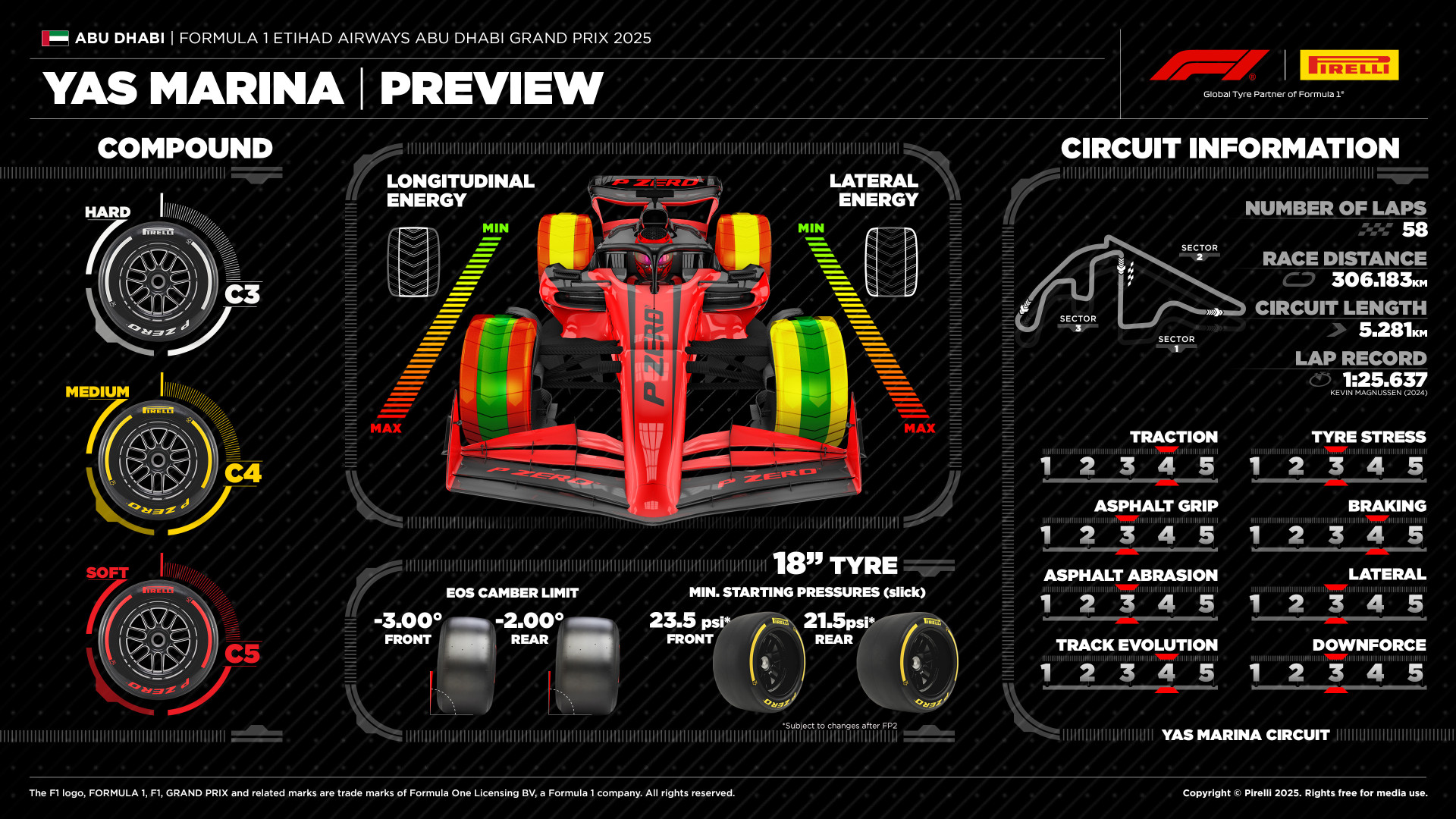
Yas Marina has hosted the final race of the Formula 1 season, 13 times. It is a modern, cutting-edge facility, the track is 5.281 kilometres long and features 16 corners.
The drivers know it well as it has long been the venue for the post-season test session. Designed by Hermann Tilke, the track underwent an overhaul four years ago, which slightly reduced its length, while making it faster and more flowing, producing more overtaking opportunities, especially on the 1.2 kilometre long straight between the slow turns 5 and 6.
Another interesting section is to be found through turns 10, 11 and 12, where drivers have to brake hard, thus generating heavy lateral loads on the car.
The track surface is made with aggregate imported from England and provides medium levels of abrasiveness and grip.
To iron out some bumpy sections, the surface was redone this year from Turn 1 to Turn 4. As at all night races, there will be a significant drop in temperature between the first and last sessions. Track conditions can change according to when the cars are on track and they will also be affected by how much it rubbers in thanks to the support races, including Formula 2.
Pirelli is sticking with the usual selection of compounds for the last race of the season, namely the C3 (Hard), C4 (Medium) and C5 (Soft).
Historically, the Yas Marina track sees graining on the tyres, but as from last year this phenomenon seems to be relatively limited and the greater resistance of the current tyres could reduce it to such an extent that even the Soft, usually only used in qualifying, could be a tyre around which to put together a race strategy.
In Yas Marina last year, 19 drivers fitted the Medium for the start, the sole exception being Hamilton who went with the Hard. The one-stop was the quickest strategy, using the hard for the second stint.
 Jordan's Track Talk
Leave a comment