The Las Vegas Grand Prix is the last of three rounds of this year’s world championship to be held in the United States, before the season comes to a close with the final two races in the Middle East.
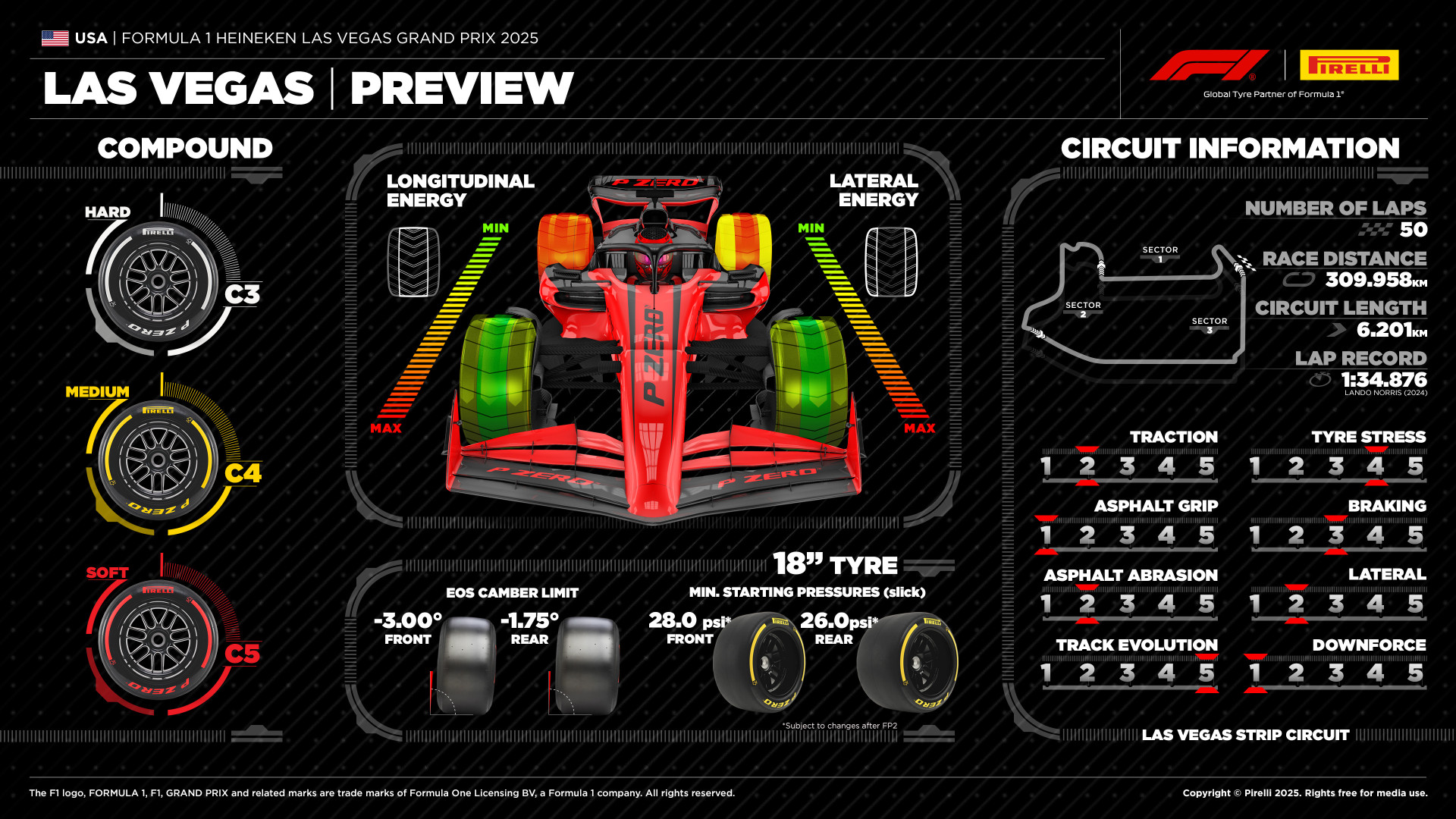
The race is run over 50 laps of the Las Vegas circuit, which has 17 corners and is unique because of the speeds attained and its technical layout.
At 6.201 kilometres, it is the second longest on the calendar after Spa and one of the fastest in terms of average lap speed.
In 2024, Alex Albon in his Williams hit the highest top speed of the season (368 km/h) on the straight between turns 12 and 14. At the latter corner, drivers experience very strong deceleration when braking and it is one of the best overtaking opportunities.
Almost 80% of the lap is spent at full throttle, the cars passing famous landmarks such as the Venetian and Casears Palace, which hosted the first two Las Vegas GPs.
For the third consecutive year, the compounds chosen for the Las Vegas street circuit are the C3 (Hard), C4 (Medium), C5 (Soft). One of the main challenges will be tyre temperature management especially during qualifying.
The fact the sessions are running earlier this year will help the drivers, as conditions won’t be quite as cold, thus helping tyre warm-up.
However, the preparation lap prior to the flying lap will still be crucial to get the tyres up into the right temperature window. Furthermore, this year’s tyres have improved mechanical properties, which should see a reduction in degradation, which was particularly noticeable on the medium compound last year.
All but four drivers chose to start on the medium, Fernando Alonso went for the soft, while Sergio Perez, Valtteri Bottas and starting from pitlane Franco Colapinto, preferred the hard.
The two-stop was the preferred strategy, drivers pushing tyres to the limit rather than having to manage them carefully.
 Jordan's Track Talk
Leave a comment